How to Turn or Rotate a Mattress (UK Guide)
By Kaiser Khan, Editor Updated First published
Desk research from official sources. Not a product test or medical advice. How we check facts.
In short
Turning a mattress means flipping it upside down. Rotating means swapping the head and foot ends. Most modern mattresses are one-sided, so you rotate them but do not flip them. Flip only two-sided models. Without maker instructions, UK bed-industry advice is weekly moves for the first three months, then monthly. Follow the label first.
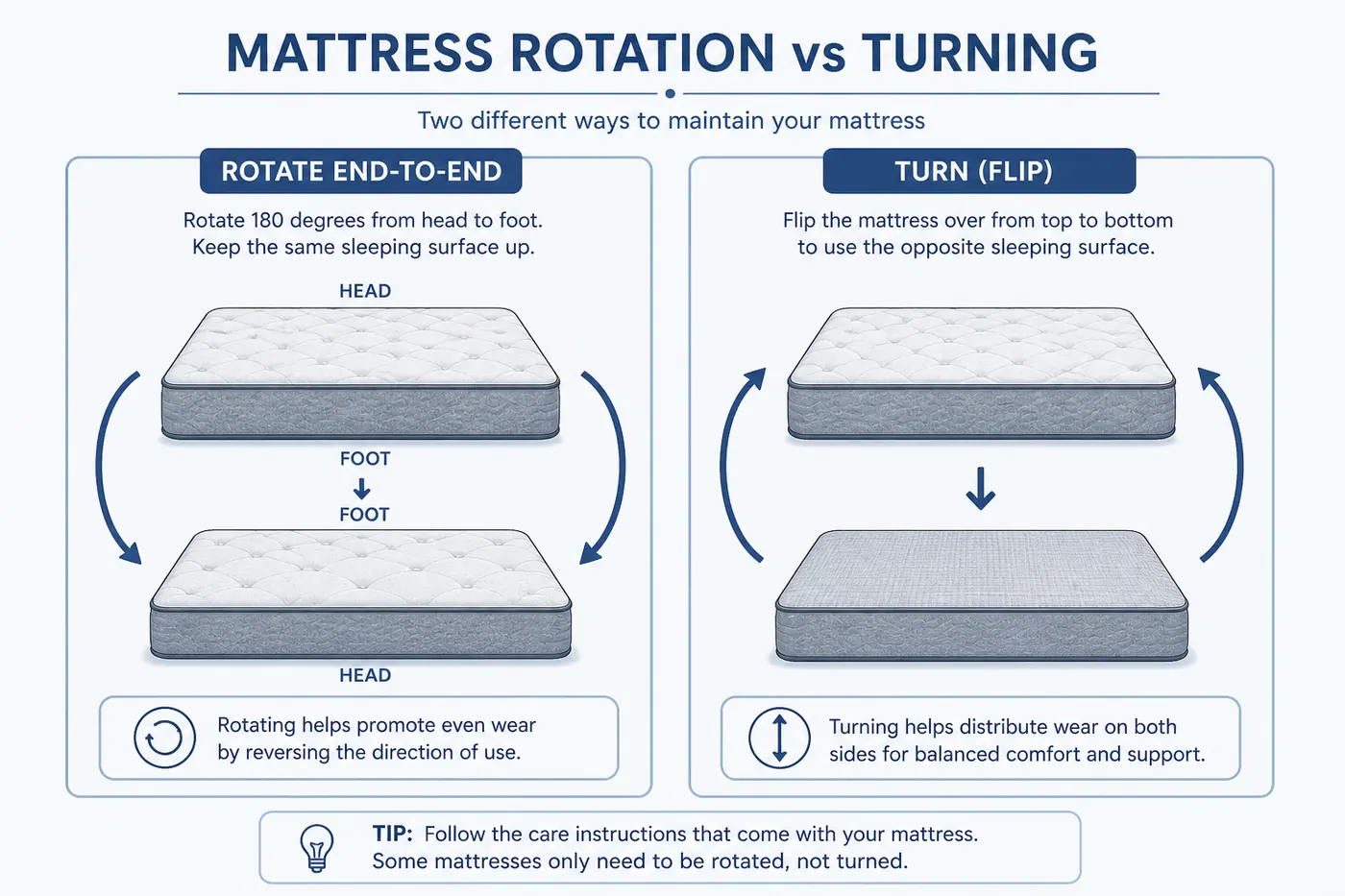
- Swap the head and foot ends. The same side stays on top.
- Rotate
- Turn the mattress upside down. Two-sided mattresses only.
- Flip
- Rotation for the first three months, if the label says nothing
- Weekly
- Rotation after the first three months
- Monthly
- The safe way to turn or flip a heavy mattress
- 2 people
- Are for positioning the mattress, not for lifting or carrying it
- Handles
The move a one-sided (no-turn) mattress needs.
Flipping a one-sided mattress puts its comfort layers underneath.
National Bed Federation Bed Advice starting schedule.
Some makers say once a season instead. Your label comes first.
Hypnos warns against turning a mattress on your own.
Sewn-on handles are not built to take the full weight of the mattress.
About 9 minutes to read
How it works
Should you turn or rotate a mattress?
It depends on how your mattress is built. Look at the sewn-in label first. It tells you which moves are allowed.
- Rotate means spinning the mattress round on the bed. The head end goes to the foot end. The same side stays facing up.
- Turn or flip means turning it upside down. The bottom side becomes the new sleeping side.
Most mattresses sold today are one-sided. Shops call them “no-turn” or “rotate only” mattresses. You rotate them, but you never flip them. A two-sided mattress has comfort layers on both faces. You can rotate it and flip it.
In short: rotate almost any mattress, unless the maker says not to. Flip only a two-sided mattress. The table further down lists the exceptions.
For a quick side-by-side, see turning vs rotating a mattress.
Why turn or rotate a mattress at all?
Your body presses on the same spots every night. Over time, the fillings settle under your hips and shoulders. This settling leaves shallow dips called body impressions. Some settling is normal in any mattress. See body impressions and sag.
Rotating moves those worn areas away from where you lie. Flipping gives a two-sided mattress a fresh face to rest on. Both moves help the fillings settle more evenly.
Neither move can fix a mattress that has worn out. Do not put a rigid board between the mattress and the base to “fix” a sag. A deep sag usually means it is time to check the whole bed. See mattress lifespan by material and when to replace a mattress.
How often should you rotate a mattress?
Follow the instructions for your exact model first. If the label says nothing, use a starting schedule. The National Bed Federation is the UK trade body for bed makers. Its Bed Advice care guide suggests this:
| Mattress | First three months | After three months |
|---|---|---|
| One-sided (no-turn) | Rotate every week | Rotate every month |
| Two-sided | Rotate one week, flip the next | Keep alternating once a month |
Makers ask for more moves early on. That is when new fillings bed down. After that, the moves can be less frequent.
Some makers set a different rhythm. The Hypnos care guide asks for weekly moves at first, then one move each season. The Vispring care guide suggests turning twice a month at first, then once a season. Your own label always beats a general schedule.
Which mattresses can you flip?
Use this table as a guide. The label on your mattress is the final word.
| Mattress type | Flip it? | Rotate it? | Notes |
|---|---|---|---|
| Two-sided traditional or natural-filled | Yes | Yes | Both faces are sleeping surfaces. Alternate flips and rotations. |
| One-sided (no-turn) pocket sprung | No | Yes | Comfort layers sit on the top face only. |
| Memory foam | No | Yes | Soft memory foam sits on a firmer base foam. |
| Hybrid (springs plus foam) | Usually no | Yes | Most have foam comfort layers on one face. Check the label. |
| Latex | Check the label | Yes | Some are two-sided and some are not. |
| Pillow top or euro top | No | Yes | The padded top layer is on one side only. |
| Zoned support | Check the label | Check the label | Rotating moves the zones. Some makers mark a fixed head end. |
| Split tension (one piece) | Check the label | Ask the maker | A flat rotation swaps the firmer and softer sides. |
Learn more about each type: pocket sprung, memory foam, hybrid, latex, pillow tops, natural fillings, zoned support and split tension.
Not sure which kind you have? Look for words like “no turn”, “non-turn” or “rotate only” on the label. Looks alone are not proof. When in doubt, rotate only and ask the maker.
Can you flip a memory foam mattress?
Usually no. A memory foam mattress is built in layers. The soft memory foam sits on top. A firmer base foam sits underneath to hold you up.
If you flip it, you sleep on the hard base foam. The soft layer gets squashed against the bed base. It will feel wrong, and it may wear badly.
TEMPUR’s UK care page, for example, says its mattresses do not need flipping. Rotating head to foot is still useful. It moves the worn area away from your hips. For spills, see cleaning memory foam.
How do you turn a heavy mattress safely?
Mattresses are heavy and floppy. Two people make the job safer and easier. The Hypnos care guide warns against turning a mattress on your own.
Many mattresses have handles on the sides. They help you slide the mattress into place. They are not made to carry its full weight. Pulling hard on them can tear the border.
To rotate a mattress:
- Take off the bedding and the mattress protector.
- Unzip a zip-and-link mattress first. See joining zip-and-link mattresses.
- Stand one person at each end.
- Slide the mattress round on the base, a little at a time.
- Stop when the head and foot ends have swapped places.
- Line it up square with the base.
To flip a two-sided mattress:
- Clear a space beside the bed.
- Lift one long edge together, and tip the mattress up onto its side.
- Keep it straight and upright. Do not let it fold in the middle.
- Lower it gently back down, so the other face is on top.
- Rotate it too, if your schedule says so.
Never bend or roll a sprung mattress to make it easier. The National Bed Federation says this can permanently damage the springs. It can also cancel the guarantee. If it feels too heavy, stop and find another helper.
What if one partner is much heavier?
The heavier person’s side usually wears faster. Deeper body impressions may form there first.
Rotating helps. A head-to-foot rotation also swaps the left and right sides. So each side takes a turn under the heavier sleeper. On a two-sided mattress, flipping adds a second face to share the wear.
A split tension mattress is different. It has a firmer side and a softer side in one piece. A flat rotation would swap them over. Ask the maker how to care for it.
If the two sides still wear very differently, the bed may not suit you both. See couples and zip-and-link and mattress support for higher body weight.
Do you need to rotate a mattress if you sleep alone?
Yes, it still helps. You may sleep in the same spot every night. That spot wears faster than the rest.
Rotating moves the worn area away from you. You could also switch sides of the bed now and then. Both habits spread the wear.
Do guest-room mattresses need turning?
A guest bed gets far less use, so it wears more slowly. It still gains from an occasional move.
A simple habit is to rotate it when the seasons change. You could also rotate it just before guests arrive. Air it at the same time. Strip the bed and leave the mattress uncovered for a few hours.
Guest beds often use different kinds of mattress. A truckle is a second low bed that slides out from under the main bed. See guest room, day bed and truckle.
Why are most mattresses “no-turn” now?
A no-turn mattress puts all its comfort layers on the top face. The underside is a plain base layer. It is not meant for sleeping on.
This design suits foam, hybrid and pillow-top mattresses. It also suits mattresses that are rolled and boxed for delivery. The plus side is less work. You rotate, but you never flip. The trade-off is that wear builds up on one face only.
Read more in why most mattresses are no-turn now.
Does turning or rotating affect my warranty?
It can. Many makers make care part of the guarantee. A guarantee is the maker’s promise to fix faults.
The Hypnos care guide says skipping its turning instructions leads to deep dips in the fillings. It also says bending the mattress, or lifting it by the handles, can cancel the guarantee. Flipping a no-turn mattress can also count as wrong use.
Keep the care label on the mattress. Keep your receipt too. See what voids a mattress warranty and mattress warranty explained.
A simple rotation schedule
Here is an easy plan to follow. Change it if your label says something different.
- Weeks 1 to 12: pick one day each week. Rotate the mattress. If it is two-sided, flip it on alternate weeks.
- After three months: rotate once a month. The first weekend of the month is easy to remember.
- Two-sided mattresses: use a four-step cycle. Flip, rotate, flip, rotate. After four moves, each face has spent time at each end.
- Seasonal makers: some makers say once a season. Move it at the start of spring, summer, autumn and winter.
Tie the job to one you already do, like changing the sheets. Wash or change your protector at the same time. A washable protector helps keep stains and dust away from the mattress. See mattress protectors and encasements and dust mites in the mattress environment.
Check the base now and then too. A base with gaps or broken slats can cause dips that rotation cannot fix. See slatted bases.
Related BedGuide entries
Frequently asked questions
What is the difference between turning and rotating a mattress?
Rotating spins the mattress round so the head end goes to the foot end. The same side stays on top. Turning, or flipping, turns it upside down so the bottom side becomes the sleeping side.
How often should you rotate a mattress?
Follow the maker's label first. If it says nothing, rotate every week for three months, then once a month. That is National Bed Federation advice. Some makers ask for once a season after the first months.
Should you flip a mattress?
Only if it is two-sided. Most modern mattresses are one-sided, or no-turn. They have comfort layers on top only. Rotate them head to foot, but do not flip them.
Can you flip a memory foam mattress?
Usually no. Soft memory foam sits on top of a firmer base foam. If you flip it, you sleep on the firm base and squash the soft layer. Rotate it head to foot instead.
Why are most new mattresses no-turn?
No-turn mattresses put all the comfort layers on the top face. This suits foam, hybrid and pillow-top designs and rolled delivery. The trade-off is that wear builds up on one face only, so rotation matters.
Can I lift a mattress by its handles?
No. Handles on the side are for sliding the mattress into position on the base. They are not made to carry its full weight. Pulling hard can tear the border and may affect the guarantee.
Do I need to rotate my mattress if I sleep alone?
Yes. If you sleep in the same spot each night, that area wears faster. Rotating moves the worn area away from where you lie, so the mattress wears more evenly.
Should I rotate a mattress if one partner is heavier?
Yes. The heavier person's side usually dips first. A head-to-foot rotation also swaps the left and right sides, so wear is shared. Split tension mattresses are different, so ask the maker.
Do guest bed mattresses need turning?
Less often, because a guest bed gets less use. An occasional rotation still helps. A simple habit is to rotate and air it when the seasons change or before guests arrive.
Does not rotating a mattress affect the warranty?
It can. Many makers make turning or rotating part of their care rules. Dips caused by skipped rotation may not count as a fault. Keep the care label and follow it.
Where do these facts come from?
BedGuide is desk research. The numbers and rules on this page were checked against the official or primary sources below. We name the check date. We do not invent a figure when a source is missing.
- National Bed Federation Bed Advice — caring for your bed — Explains one-sided and two-sided care. Without maker instructions, it advises weekly rotation or alternating rotation and turning for three months, then monthly moves. Checked 2026-09-25.
- Hypnos — bed care guide and guarantee (PDF) — Maker care guide. Says no-turn and pillow-top mattresses rotate only, not to turn a mattress alone, and that sewn-on handles are for positioning, not lifting. Checked 2026-09-25.
- Vispring — mattress care guide — Maker care guide. Suggests turning twice a month for the first three months, then once each season. Checked 2026-09-25.
- TEMPUR UK — cleaning and care — Maker care guide for foam mattresses. Says its mattresses do not need flipping and that an occasional head-to-foot rotation can help. Checked 2026-09-25.