Mattress Types UK: 8 Types of Mattress Compared
By Kaiser Khan, Editor Updated First published
Desk research from official sources. Not a product test or medical advice. How we check facts.
In short
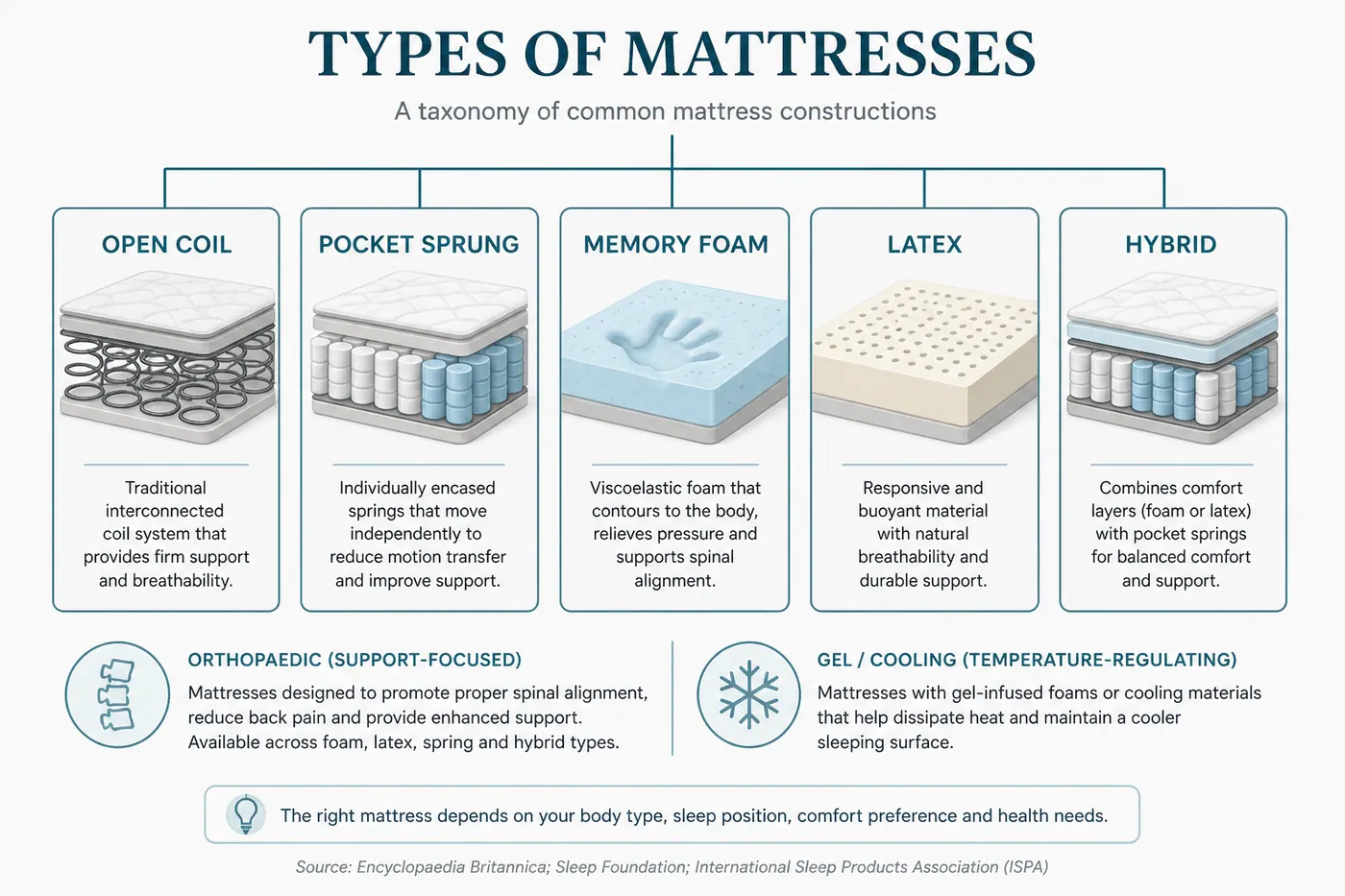
The main UK mattress types are pocket sprung, open coil, continuous coil, memory foam, reflex foam, latex, hybrid and natural-filled. The core decides support. The top layers decide feel. Bed-in-a-box is a way of delivering a mattress, not a type. Compare the build, then check size, base and care rules.
- How to read any type
- Core + comfort
- UK mattress types
- 8 main builds
- Bed-in-a-box
- Not a type
- Open coil in a 150 cm King (NBF)
- At least 325 coils
- Orthopaedic, cooling, eco
- Label, not build
The core supports you. The top layers set the feel.
Pocket, open coil, continuous coil, memory foam, reflex, latex, hybrid, natural.
A rolled delivery method. Inside is usually foam or hybrid.
Pocket units often run from 600–800 up to 2,500 springs.
These words describe a claim. Ask what is inside.
About 7 minutes to read
How it works
What are the main types of mattress in the UK?
Every mattress has a core and a comfort layer. The core holds you up. The comfort layer is the padding on top. Mattress types are named after the core. Many mattresses mix materials, so read the full layer list.
| Type | What’s inside | Feel | Partner movement | Heat | Turning | Typical weight |
|---|---|---|---|---|---|---|
| Pocket sprung | Springs in separate fabric pockets | Bouncy, follows your shape | Usually low | Air moves between springs | Rotate; flip if two-sided | Medium to heavy |
| Open coil | Springs wired into one grid | Springy, can feel firm | Usually more | Air moves between springs | Check the label | Often lighter |
| Continuous coil | One long wire bent into linked springs | Even, springy | Usually more than pocket | Air moves between springs | Check the label | Medium |
| Memory foam | Slow foam over a firmer foam base | Slow, moulding hug | Usually low | Can feel warm | Usually rotate only | Varies with foam |
| Reflex foam | Firm, bouncy polyurethane foam | Firm, quick to spring back | Low to medium | Varies | Check the label | Often lighter |
| Latex | Rubber-based foam core or layer | Bouncy and buoyant | Low to medium | Often cooler than memory foam | Check the label | Often heavy |
| Hybrid | Springs under thick foam or latex | Bouncy base, softer top | Usually low | Depends on top layer | Usually rotate only | Often heavy |
| Natural fillings | Wool, cotton or horsehair, often over springs | Springy, lofty | Depends on core | Wool lets moisture pass | Some are two-sided | Can be heavy |
| Bed-in-a-box | Usually foam or hybrid, rolled for delivery | Depends on build | Depends on build | Depends on build | Usually rotate only | Varies |
These are general patterns, not test results. Always check the exact model’s layer list, care label and weight in kilograms.
What makes a mattress pocket sprung?
A pocket sprung mattress has springs that each sit in their own fabric bag. The National Bed Federation (NBF) says these springs work independently. So your partner’s movement usually travels less. Counts often run from 600–800 up to 2,500 springs.
What is an open coil mattress?
An open coil mattress has springs joined by spiral wire. It is also called a Bonnell spring unit. The NBF says a 150 cm size usually has at least 325 coils. The linked grid moves together, so partner movement travels more. Compare them in pocket sprung vs open coil.
What is a continuous coil (Miracoil) mattress?
A continuous coil unit is one long wire bent into rows of springs. The NBF says this gives a higher count and a more responsive feel than open coil. Miracoil is a Silentnight brand name for a linked system. See Miracoil explained.
What is a memory foam mattress?
A memory foam mattress uses a foam that softens with body heat. It moulds slowly to your shape. It usually sits on a firmer foam base. Gel is often added with a cooling claim. See gel and cooling claims and memory foam vs latex.
What is a reflex foam mattress?
Reflex foam is a UK shop name for firm, bouncy polyurethane foam. It springs back faster than memory foam. You often find it in guest beds and sofa beds. Density and thickness decide how long it lasts.
What is a latex mattress?
A latex mattress uses foam made from rubber tree sap, man-made latex or a blend. The NBF describes latex as resilient and naturally cooler than traditional foam. It springs back quickly. There are two main ways to make it, called Dunlop and Talalay. See Talalay vs Dunlop.
What is a hybrid mattress?
A hybrid mattress puts springs under a thick layer of foam or latex. The springs are often pocket springs. The word hybrid does not tell you how thick each layer is. Ask for the layer list. See hybrid vs pocket sprung and memory foam vs hybrid.
What is a natural filling mattress?
A natural filling mattress uses wool, cotton, horsehair or similar fibres. They usually sit above a spring core. The NBF describes wool as breathable, so air and moisture pass through it. Deep natural fillings can settle, so some models are made to turn. See natural fillings.
Is bed-in-a-box a mattress type?
No. Bed-in-a-box describes delivery, not the build. The mattress is squashed, rolled and boxed. It expands after you open it. Most are foam or hybrid. See bed-in-a-box mattresses and bed-in-a-box vs traditional.
Which mattress type is best for side, back or stomach sleepers?
No type wins for one sleep position. Support comes first. The NBF says heavier people generally need a firmer tension. Top feel then depends on how you lie:
- Side sleepers often want more give at the shoulder and hip. See the side sleeper guide.
- Back sleepers often want even support without deep sinking. See the back sleeper guide.
- Stomach sleepers often want less sink so the hips do not drop. See the stomach sleeper guide.
- If you move between positions, see the combination sleeper guide.
The NBF says firm is not automatically best for back pain. If you have pain, ask a GP or physiotherapist. This page is not medical advice.
What mattress do hotels use?
There is no single hotel mattress type. What we can source is the fire grade. SATRA, a UK test house, lists hotels as typical medium or high hazard settings under BS 7177. So hotel mattresses usually pass tougher fire tests than home mattresses. If you liked a hotel bed, ask the hotel for the maker and model. See BS 7177 fire labels.
Which mattress type lasts longest?
It depends more on quality and care than on type. BedGuide’s educational ranges put latex cores at about 8–12 years. Pocket sprung and hybrid sit at about 7–10 years. Open coil sits at about 5–8 years. These are not warranty promises.
Body weight, rotation and the base change real life. A cheap latex blend can wear faster than a well-made spring unit. See mattress lifespan by material.
What do orthopaedic, cooling and eco mean?
These words are labels on top of a type. Ask what physical feature the label means.
| Label | What to check |
|---|---|
| Orthopaedic | The build and the tension. It is not a medical claim. |
| Cooling or gel | Which material, where it sits, and how any test was run |
| Pillow-top | The attached top layer and whether you can turn it |
| Eco or natural | Which materials, how much, and which part of the mattress |
Which UK size should I choose?
A UK Single is 90 × 190 cm. A Small Double is 120 × 190 cm. A Double is 135 × 190 cm. A King is 150 × 200 cm. A Super King is 180 × 200 cm. See the UK bed size table.
What should I check before placing an order?
- Note the exact size, depth and weight.
- Check your base against the maker’s rules, including slat gaps.
- Read whether the mattress is one-sided or made to turn.
- Check delivery access to your room.
- Read the trial and return terms.
See how to choose a mattress and how to choose a bed base.
Where can I find UK mattress companies?
The Bed & Mattress Directory lists UK companies alphabetically. It is not a league table or an endorsement. Confirm the exact model with the seller.
Frequently asked questions
What are the main types of mattress in the UK?
The main types are pocket sprung, open coil, continuous coil, memory foam, reflex foam, latex, hybrid and natural-filled. Many mattresses mix them, so read the full layer list.
Which type of mattress is best?
No type is best for everyone. Match support to your body weight first. Then pick the top feel for how you sleep. Then check size, base and care.
What is the difference between pocket sprung and memory foam?
Pocket springs sit in separate fabric bags and push back fast. Memory foam softens with body heat and moulds slowly. Springs feel bouncier. Foam feels more like sinking in.
What is the difference between pocket sprung and continuous coil?
Continuous coil is one long wire bent into rows of linked springs. Pocket springs are separate, each in its own bag. Linked springs usually pass on more partner movement.
Which mattress type sleeps coolest?
No type is cool in every bedroom. Spring cores leave space for air. The NBF says latex is naturally cooler than traditional foam. Covers, protectors and duvets still matter a lot.
Which mattress type is best for couples?
Pocket sprung, memory foam and hybrids usually pass on less movement than linked springs. If your weights differ a lot, look at zip-and-link or split tension.
Which mattress type lasts longest?
Latex cores often keep their shape well, and open coil tends to wear faster. But materials, use, rotation and the base matter more than the type name.
Is a hybrid the same as pocket sprung?
Not quite. A hybrid has springs, often pocket springs, under a thick foam or latex layer. A pocket sprung mattress may use wool, cotton or thin foam on top instead.
Is orthopaedic a type of mattress?
No. Orthopaedic is a shop label, not a build. It usually means a firmer feel. It is not a medical claim. Ask what is inside and which tension it uses.
Can any mattress go on any bed base?
No. Follow the rules for the exact mattress and base. Check slat gaps, centre support and load limits. Adjustable beds need model approval.
Where do these facts come from?
BedGuide is desk research. The numbers and rules on this page were checked against the official or primary sources below. We name the check date. We do not invent a figure when a source is missing.
- National Bed Federation (Bed Advice) — how to choose a mattress — How open coil, continuous, pocket and mini springs are built. Typical spring counts. Foam and latex notes. Checked 2026-09-25.
- National Bed Federation (Bed Advice) — buying a bed that is right for you — Heavier people generally need firmer tension. Partners of very different weights may need different mattresses. Checked 2026-09-25.
- National Bed Federation (Bed Advice) — myths about mattress buying — Firm is not automatically best for back pain. Spring counts can mislead. The base affects comfort. Checked 2026-09-25.
- SATRA — fire testing of beds (BS 7177 hazard categories) — Lists hotels among typical medium or high hazard settings for mattress fire testing. Checked 2026-09-25.
- Simba: model-specific base requirements — Example of one maker's base rules. Shows why base checks are model specific. Checked 2026-09-08.