Zip and Link Mattresses: UK Sizes, Pros and Cons
By Kaiser Khan, Editor Updated First published
Desk research from official sources. Not a product test or medical advice. How we check facts.
In short
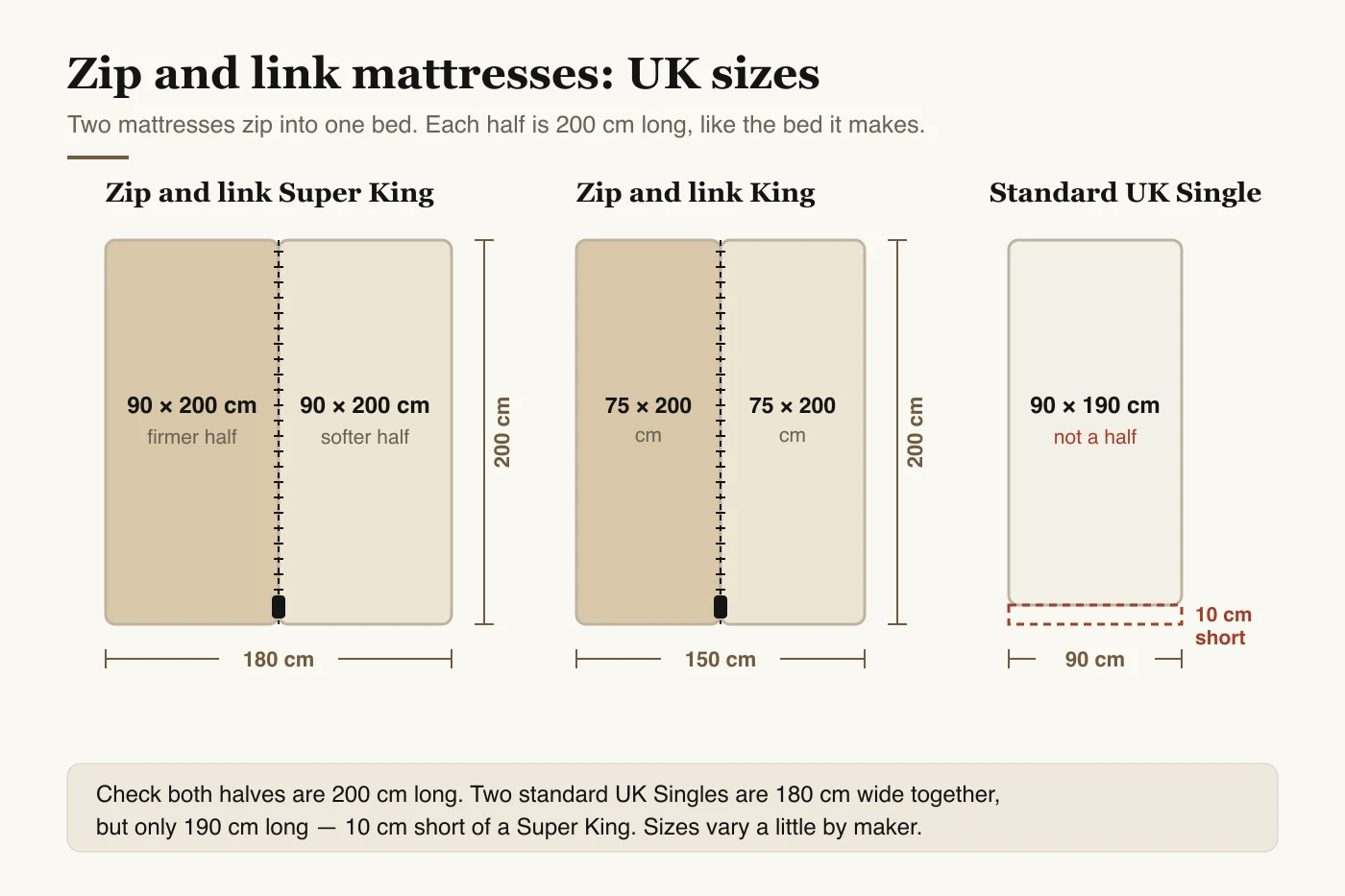
A zip and link mattress is two mattresses zipped together into one bigger bed. Each half can have its own firmness. A UK Super King set is usually two 90 × 200 cm halves. A King set is usually two 75 × 200 cm halves. Two standard 90 × 190 cm Singles are 10 cm too short.
- Super King zip and link halves
- 2 × 90 × 200 cm
- King zip and link halves
- 2 × 75 × 200 cm
- Two standard UK Singles side by side
- 180 × 190 cm
- Zip and link vs split tension
- Two units
They join into 180 × 200 cm, the standard UK Super King size.
They join into 150 × 200 cm, the standard UK King size.
Super King width, but 10 cm shorter than a 200 cm Super King.
Zip and link is two mattresses. Split tension is one mattress with two bands.
About 8 minutes to read
How it works
What is a zip and link mattress?
A zip and link mattress is two mattresses that zip together into one bigger bed. Each half is a full mattress on its own.
A zip runs along the joining edge of each half. Close the zip and the two halves act as one wide bed. Open it and you have two narrow beds again.
The “link” part usually means the bases. Two half bases are held together with linking bolts or bars. These are metal fixings that keep the bases side by side. See the zip and link glossary.
In short: two mattresses, one zip, one bigger bed.
What sizes do zip and link beds come in?
UK zip and link sets are usually a King or a Super King. The halves are not always standard UK Singles. Check the size of each half, not only the joined size.
| Joined size (cm) | Each half (cm) | Notes |
|---|---|---|
| Super King 180 × 200 | 2 × 90 × 200 | Each half is 10 cm longer than a UK Single. |
| King 150 × 200 | 2 × 75 × 200 | Each half is narrower than a UK Single. |
| Extra King 180 × 190 (some makers) | 2 × 90 × 190 | Two standard UK Singles. 10 cm shorter than a Super King. |
| Emperor 200 × 200 (some makers) | Ask the maker | Not a fixed UK size. An even split is 2 × 100 × 200. |
These are common patterns, not fixed rules. Check the brand’s size page and the label before you order. Full charts: UK standard bed sizes and Emperor bed dimensions.
Do two single beds make a super king?
Not quite. A standard UK Single is 90 × 190 cm. Two side by side make 180 × 190 cm. A UK Super King is 180 × 200 cm. The width matches, but the bed is 10 cm too short.
That is why Super King zip and link halves are usually 90 × 200 cm. Some shops call this size a Euro single or long single. It is 10 cm longer than a UK Single.
Two ordinary Single beds pushed together have no zip. There is often a gap and a height step. See guest room and truckle beds.
In short: two standard Singles give you Super King width, not Super King length.
Can you use zip and link mattresses as two single beds?
Yes. Unzip the halves and move them apart. Each half becomes a narrow single bed. This suits spare rooms that host a couple one week and two friends the next. It also suits holiday lets, B&Bs and hotels.
Each half needs its own base when apart. A Super King half is 90 × 200 cm. It needs a 90 × 200 cm base, not a 90 × 190 cm Single base. On a Single base, 10 cm hangs over the end. King halves need 75 × 200 cm bases.
Will standard sheets fit a zip and link bed?
Joined, yes. The joined set is a normal UK size. A Super King fitted sheet fits a 180 × 200 cm set. A King fitted sheet fits a 150 × 200 cm set.
Match the pocket depth too. Pocket depth is how deep the sheet’s sides are.
Apart, standard Single sheets will not fit well. A UK Single sheet is cut for 90 × 190 cm. A 90 × 200 cm half needs a sheet made for 90 × 200 cm. Shops may call it Euro single or long single. King halves are 75 × 200 cm, so check a shop lists that size. See UK fitted sheet sizes.
Can you feel the zip in the middle?
You do not usually lie on the zip itself. It often sits on the side border, below the sleeping surface. But you may feel the join. The join is the line where the two halves meet.
It can feel like a slight dip or ridge. You notice it most if you lie across the middle. Ways to soften it:
- A bridge pad or bridge cover. This is a padded strip or cover that sits over the join.
- A full-width mattress topper. A topper is a thinner extra layer that goes on top.
If the halves have very different firmness, one side may sink more. Lie across the middle in the shop to check. See how to try a mattress in a shop.
Zip and link vs split tension: what is the difference?
Both let each sleeper have a different feel. They are built in different ways.
- Zip and link is two mattresses joined by a zip.
- Split tension is one mattress with two firmness bands inside one cover. Spring tension means how hard the springs push back.
| Question | Zip and link | Split tension |
|---|---|---|
| How many mattresses? | Two | One |
| Soft one side, firm the other? | Often possible | Some makers keep the two bands one step apart |
| Stairs | Two smaller pieces | One large piece |
| Use as two beds? | Yes, with two bases | No |
| The middle | A zip join | A change in feel under one cover |
Full guide: split tension mattresses. Side by side: split tension vs zip and link.
Who is zip and link for?
Zip and link can suit you if:
- Your body weights differ a lot. Heavier sleepers often need firmer springs. One shared tension is a compromise. See spring tension vs comfort feel.
- You like different firmness. One of you likes soft. The other likes firm. Some makers only sell a soft and firm pair as zip and link.
- Your stairs are narrow. Two 90 cm halves turn tight corners more easily than one 180 cm mattress. Measure first: bed footprint and access.
- You have a dual adjustable base. Each side of the base moves on its own. Use only the mattress setup the base maker approves. Do not assume a zipped pair can stay joined while one side moves. See adjustable beds.
It may not suit you if you both like the same feel. One well-chosen mattress is simpler. It has no join.
What are the drawbacks of zip and link beds?
- The join. Some people feel the middle line. A bridge pad helps, but it may not hide it fully.
- Bases. To use the halves apart, you need two bases of the right size. One Super King base only works when the halves are joined.
- Sheets. Apart, each half needs sheets cut for its own size.
- Fewer choices. Not every range comes as zip and link. Some sets are made to order, so delivery can take longer.
- Returns. Made-to-order items can have different return terms. See UK bed refund and return rights.
What base and headboard do you need?
Bases. Joined, a Super King set can sit on a standard 180 × 200 cm Super King base or frame. Many zip and link beds use two half bases instead. Linking bolts hold them together. Two half bases let you split the bed later.
Both bases must be the same height, so the join sits level. Step by step: how to join zip and link mattresses.
Headboards. A full-width Super King headboard makes it look like one bed. But it has to come off if you split the bases. Two single-width headboards can stay on each base instead.
Check the strut centres first. Strut centres are the gap between a headboard’s two upright legs. They must line up with the bolt holes on the base. See headboards and headboard strut centres.
How do you turn or rotate zip and link mattresses?
Unzip the halves first. Then care for each half like its own mattress. Each half is lighter than one big mattress, so it is easier to move.
- Rotate means spin it so the head end goes to the foot end. The same face stays on top.
- Turn or flip means turn it over. Only do this if the half is two-sided. Two-sided means both faces are made to sleep on.
Watch the zip. Rotating a half also swaps its two long sides. A zip on the inner edge can end up on the outer edge. Some makers fit zips on both long edges so each half can stay on its own side. Check the maker’s care guide.
With no maker instructions, UK bed-industry advice is to rotate a one-sided mattress weekly for the first three months. After that, rotate it monthly. Full guide: turning vs rotating.
Motion and heat for couples
Two halves can cut roll-together. That is when both sleepers slide into a dip in the middle. Some movement can still pass through a shared base. See motion isolation.
Heat is a separate question. A zip does not make a bed cooler. See mattress heat and cooling.
Related BedGuide entries
Frequently asked questions
What is a zip and link mattress?
It is two mattresses that zip together along one long edge to make one bigger bed. Each half can have a different firmness. Unzip them and you have two narrow beds again.
What size is each half of a zip and link Super King?
Usually 90 × 200 cm. Two halves join into 180 × 200 cm, the UK Super King size. A King set is usually two 75 × 200 cm halves. Always check the size on the label.
Do two single beds make a super king?
Not quite. A standard UK Single is 90 × 190 cm. Two side by side make 180 × 190 cm. A Super King is 180 × 200 cm, so they are 10 cm too short.
Can you use zip and link mattresses as two single beds?
Yes, if each half has its own base. A Super King half is 90 × 200 cm. It needs a 90 × 200 cm base and sheets, not a standard 90 × 190 cm Single.
Will standard sheets fit a zip and link bed?
Joined, a normal fitted sheet for the full size fits, such as a Super King sheet. Apart, each 90 × 200 cm half needs a sheet cut for 90 × 200 cm, often called Euro single or long single.
Can you feel the zip in the middle of a zip and link bed?
You do not usually lie on the zip. It often sits on the side border. You may still feel a line where the halves meet. A bridge pad or a topper can soften it.
Is zip and link the same as split tension?
No. Zip and link is two mattresses joined with a zip. Split tension is one mattress with two firmness bands under one cover. Ask which one you are buying.
How do you turn a zip and link mattress?
Unzip the halves first. Then rotate or flip each half as its own care label says. Rotating can move the zip to the outer edge, so check the maker's care guide.
Where do these facts come from?
BedGuide is desk research. The numbers and rules on this page were checked against the official or primary sources below. We name the check date. We do not invent a figure when a source is missing.
- National Bed Federation Bed Advice — UK bed and mattress size guide — Lists the UK Single as 90 × 190 cm, King as 150 × 200 cm and Super King as 180 × 200 cm. Mentions zip and link sets that join into a Super King. Checked 2026-09-25.
- John Ryan By Design — mattress sizes guide (UK maker) — A UK maker's zip and link sizes. King 150 × 200 cm (halves 75 × 200 cm). Super King 180 × 200 cm (halves 90 × 200 cm). Extra King 180 × 190 cm (halves 90 × 190 cm). Checked 2026-09-25.
- Dreams — mattress size guide — Lists Single 90 × 190 cm and Euro single 90 × 200 cm. Notes two 90 cm Singles match Super King width but are 10 cm shorter. Checked 2026-09-25.
- John Ryan By Design — split tension mattresses explained — Says a soft and firm pairing is not made as one piece, but is possible as zip and link. Notes zips on both edges of each half as an option. Checked 2026-09-25.
- National Bed Federation Bed Advice — caring for your bed — Without maker instructions: rotate one-sided mattresses weekly for three months, then monthly. Alternate rotating and flipping two-sided ones. Checked 2026-09-25.