What Is a Pocket Sprung Mattress?
By Kaiser Khan, Editor Updated First published
Desk research from official sources. Not a product test or medical advice. How we check facts.
In short
A pocket sprung mattress has steel springs that each sit in their own fabric bag, called a pocket. Each spring can move more on its own. So the bed follows your shape and passes on less partner movement than linked open coils. Spring count is not a quality score. Tension, wire and top layers matter more.
- How it works
- One spring, one pocket
- Typical pocket spring counts (NBF)
- 600–800 to 2,500+
- Spring tension rule of thumb (NBF)
- Heavier = firmer tension
- Care
- Rotate; turn if two-sided
- Slat gap check
- Often about 7 cm
Each coil sits in its own fabric bag.
A count only means something next to a UK size.
Each maker sets its own weight bands.
No-turn models are rotated only.
The maker's warranty wording wins.
About 6 minutes to read
How it works
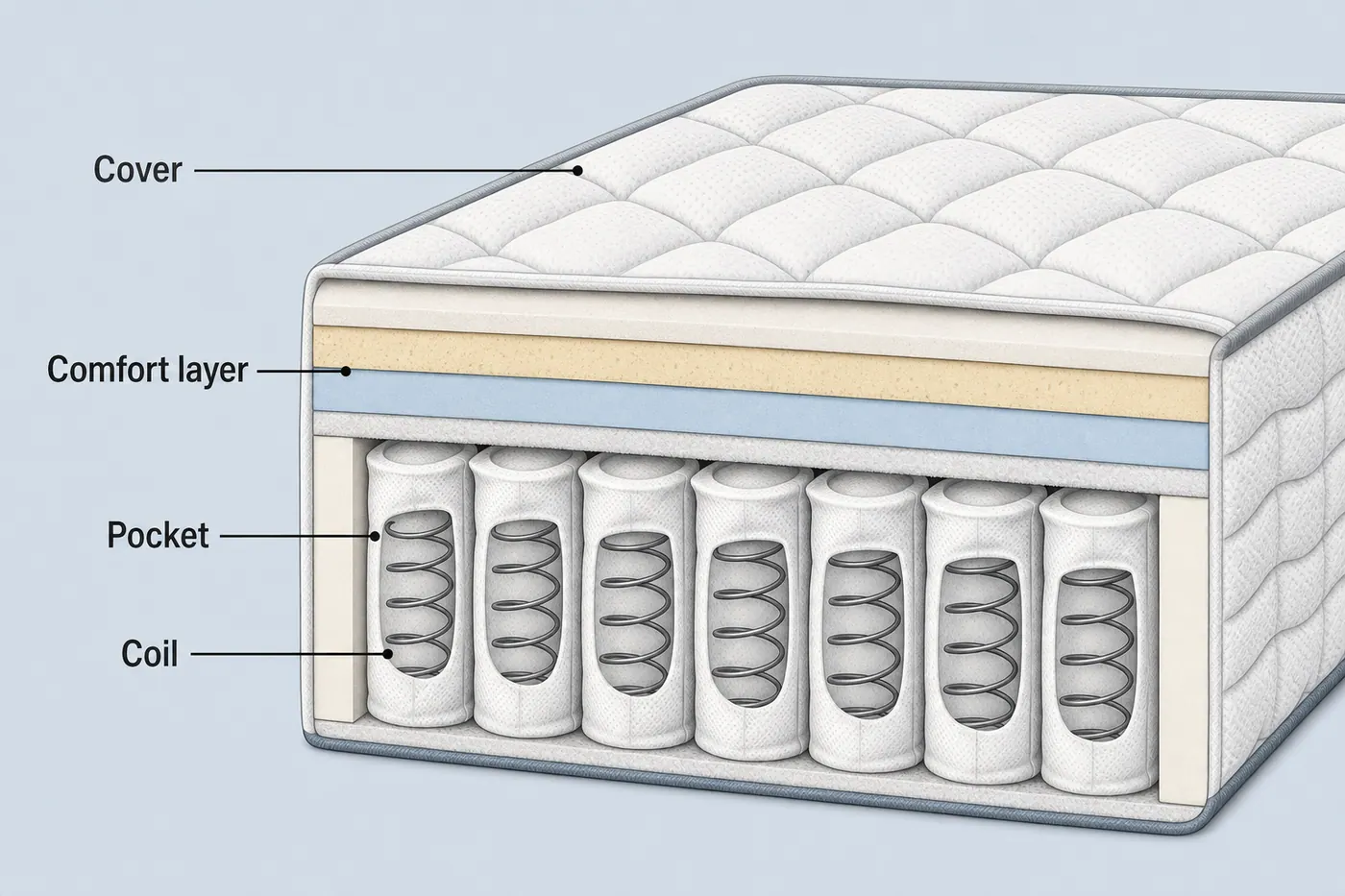
What is inside a pocket sprung mattress?
Typical builds use steel coil springs, non-woven or woven spring pockets, comfort foams or natural fillings, cover fabric. Exact stacks vary by model. Read the spec, not the shop slogan.
- steel coil springs
- non-woven or woven spring pockets
- comfort foams or natural fillings
- cover fabric
How long does a pocket sprung mattress last?
A typical range is 7– 10 years. Body weight, base support and rotation change that. It is not a warranty promise.
7– 10 years
What does pocket sprung mean?
A pocket sprung mattress has a core of steel springs. Each spring sits in its own fabric bag, called a pocket. The springs are not wired together. So one spring can squash down without dragging its neighbours with it.
The National Bed Federation (NBF) is the UK trade body for bed makers. It says pocket springs work independently. The springs give support. The soft layers on top give comfort.
In short: pocket sprung describes the core, not the whole mattress.
How does a pocket sprung mattress work?
Your shoulder presses one patch of springs. Your waist presses another. Each patch pushes back on its own, so the surface follows your shape.
A factory coils steel wire into springs. Each spring goes into a pocket. The pockets are joined into one sheet, called a spring unit. The NBF says better units often use calico pockets, a plain cotton cloth, nested by hand. Cheaper units often use non-woven fabric glued in rows. Non-woven means fibres pressed together, not woven.
Three things set how the springs push back:
- Wire gauge — how thick the wire is. Thicker wire usually feels firmer.
- Coil shape and height — taller or wider coils bend differently.
- How close the springs sit — more springs spread your weight over more points.
Wool, cotton, foam or latex sit above the springs. These layers set how plush the bed feels. Zoning means some rows are firmer than others. It is a layout, not a treatment. See wire gauge and coil types and zoned support.
Pocket sprung vs open coil: what is the difference?
An open coil mattress links its springs with spiral wire. So the grid moves together a little. A pocket unit has no linking wire.
| Question | Pocket sprung | Open coil (Bonnell) |
|---|---|---|
| How springs join | Each in its own fabric pocket | Wired into one grid |
| Partner movement | Usually less travels | Usually more travels |
| Spring count | NBF: often 600–800 up to 2,500 | NBF: usually at least 325 in a 150 cm size |
| Cost to make | Often higher | Often lower |
Open coil is not “wrong”. It is a different build. See pocket sprung vs open coil.
Pocket sprung vs memory foam: how do they feel different?
Pocket springs push back fast. Memory foam is a foam that softens with body heat and sinks slowly under you.
- Feel: springs feel bouncier. Memory foam feels more like sinking in.
- Moving about: many people find it easier to turn over on springs.
- Heat: a spring core has open space inside. A foam core is solid.
- Both at once: a hybrid mattress puts pocket springs under thick foam or latex.
See pocket sprung vs memory foam.
How many springs is a good count?
There is no single good number. Spring count is the number of springs in one stated size. One thousand springs in a Single (90 × 190 cm) sit closer together than in a Super King (180 × 200 cm).
The NBF says pocket counts often run from 600–800 up to 2,500. Some reach 3,000 or 4,000. It warns that a “5,000 spring” mattress may have only about 800 in the main core.
Ask which UK size the count is for. Then ask how many springs are in the main unit. A bigger count does not prove thicker wire or a longer life. See spring count explained and how spring count is marketed.
What are mini pockets and layered springs?
Mini pockets are tiny pocket springs in the comfort layer. The NBF says some are under 3 cm tall. They can replace foam or fibre on top.
Some mattresses stack two spring layers. A tall unit gives support. A thin mini-spring layer adds give. Names such as micro coils change by brand. A thin layer can hold thousands of springs, so the headline count jumps.
What is spring tension, and how does it relate to body weight?
Spring tension is how hard the springs push back. Shops call it soft, medium or firm.
The NBF gives a general rule: the heavier you are, the firmer the tension you usually need. A light person on firm springs may not sink in enough. A heavy person on soft springs may sink too far.
Makers set their own weight bands. For example, Vispring suggests soft up to about 70 kg (11 stone) and medium from about 70 to 102 kg. Other makers differ. Use the chart for the exact model.
Tension is not how soft the top feels. See spring tension vs comfort feel. If you have back or joint pain, ask a GP or physiotherapist.
Does a pocket sprung mattress need turning?
Only if it is two-sided. A two-sided mattress has fillings on both faces. A one-sided, no-turn mattress has comfort layers on top only. You still rotate it head to foot.
The NBF care routine is:
- One-sided: rotate weekly for three months, then monthly.
- Two-sided: switch between rotating and flipping weekly for three months, then monthly.
See turning vs rotating.
What base does a pocket sprung mattress need?
It needs a firm, even base the maker approves. Common choices are a divan base or a slatted base.
On slats, a wide gap can let the top layers sag. Many makers give a maximum gap, often about 7 cm. The warranty wording wins. The NBF says the base affects comfort and lifespan. See mattress base compatibility.
Are pocket sprung mattresses good for hot sleepers?
They can help. Air moves more easily between coils than through solid foam. But you lie on the cover, fillings, protector and duvet. A thick memory foam top can still feel warm. The NBF calls wool breathable, meaning air and moisture pass through it. See why a mattress feels hot.
Are pocket springs good for couples?
They reduce roll-together, where two people drift into the middle. Very soft top layers can still dip in the centre.
The NBF says partners about 3 stone (18 kg) or more apart may need different mattresses. See zip-and-link and split tension.
Pocket sprung mattress pros and cons
| Pros | Cons |
|---|---|
| Less partner movement usually travels | Big spring counts in adverts can mislead |
| Bouncy and easy to move on | Thin top layers can let you feel springs |
| Open core lets air move | Two-sided models need regular flipping |
| Made in tensions for different weights | Needs a firm, even base |
Related BedGuide entries
Frequently asked questions
What is the difference between pocket sprung and open coil?
Open coil springs are joined by wire into one grid, so they move together. Pocket springs sit in separate bags, so pressure stays nearer where you press. Less partner movement usually travels.
Is pocket sprung better than memory foam?
Neither suits everyone. Pocket springs feel bouncier and push back fast. Memory foam moulds slowly. Many hybrid mattresses use both. Try the feel and check the build.
How many springs should a pocket sprung mattress have?
There is no single right number. The National Bed Federation says counts often run from 600–800 up to 2,500. Ask which UK size the count is for.
Is 1000 pocket springs good?
It depends on the size. One thousand springs in a Single are packed much closer than one thousand in a Super King. Wire, tension and top layers matter more.
What are mini pocket springs?
They are very small springs in the comfort layer, above the main springs. Some are under 3 cm tall. They add give and push the headline count up quickly.
What spring tension do I need for my weight?
As a general rule, heavier people need a firmer tension. Each maker publishes its own weight bands, and they differ. Use the chart for the exact model.
Do you need to turn a pocket sprung mattress?
Only if it is two-sided. Two-sided models are flipped and rotated. One-sided, no-turn models are only rotated head to foot. The care label tells you which.
What base is best for a pocket sprung mattress?
Use a firm, even base the maker approves, such as a divan or slats. Keep slat gaps within the maker's limit, often about 7 cm.
Are pocket sprung mattresses good for hot sleepers?
They can help, because air moves around the springs. But you lie on the top layers. A thick memory foam top or heavy duvet can still feel warm.
Where do these facts come from?
BedGuide is desk research. The numbers and rules on this page were checked against the official or primary sources below. We name the check date. We do not invent a figure when a source is missing.
- National Bed Federation (Bed Advice) — how to choose a mattress — Pocket springs work independently. Typical counts, pocket fabrics, mini springs and open coil linking. Checked 2026-09-25.
- National Bed Federation (Bed Advice) — buying a bed that is right for you — Heavier people generally need a firmer tension. Partners of very different weights may need different mattresses. Checked 2026-09-25.
- National Bed Federation (Bed Advice) — caring for your bed — Rotation and flipping routines for one-sided and two-sided mattresses. Checked 2026-09-25.
- National Bed Federation (Bed Advice) — myths about mattress buying — Headline spring counts can include comfort springs. The base affects comfort and lifespan. Checked 2026-09-25.
- Vispring — mattress buying guide (tension by body weight) — One maker's published tension bands by body weight. An example only. Checked 2026-09-25.