What Is BS 7177? UK Mattress Fire Safety Labels
By Kaiser Khan, Editor Updated First published
Desk research from official sources. Not a product test or medical advice. How we check facts.
In short
BS 7177 is the British Standard for how well mattresses, mattress pads, divans and bed bases resist catching fire. A home mattress is normally labelled low hazard. That means it is tested against a smouldering cigarette and a match-sized flame. Hotels and hospitals may need higher grades. A pass does not make a mattress fireproof.
- Mattress fire standard
- BS 7177
- Home (domestic) grade
- Low hazard
- Contract grades
- Medium to very high
- 1988 regulations and mattresses
- Fillings rule
- 2025 children's mattress exclusion
- Under 170 × 75 cm
- What a pass means
- Not fireproof
Covers mattresses, mattress pads, divans and bed bases. Not protectors.
Cigarette and match-flame tests. Typical for homes, including non-motorised caravans.
Hotels, hostels, halls, hospitals and prisons may need tougher grades.
For mattresses, the 1988 rules cover the fillings. The whole mattress is labelled to BS 7177.
Must be under both limits. General product safety rules still apply.
Tests set ignition resistance. They do not stop a fully developed fire.
About 7 minutes to read
How it works
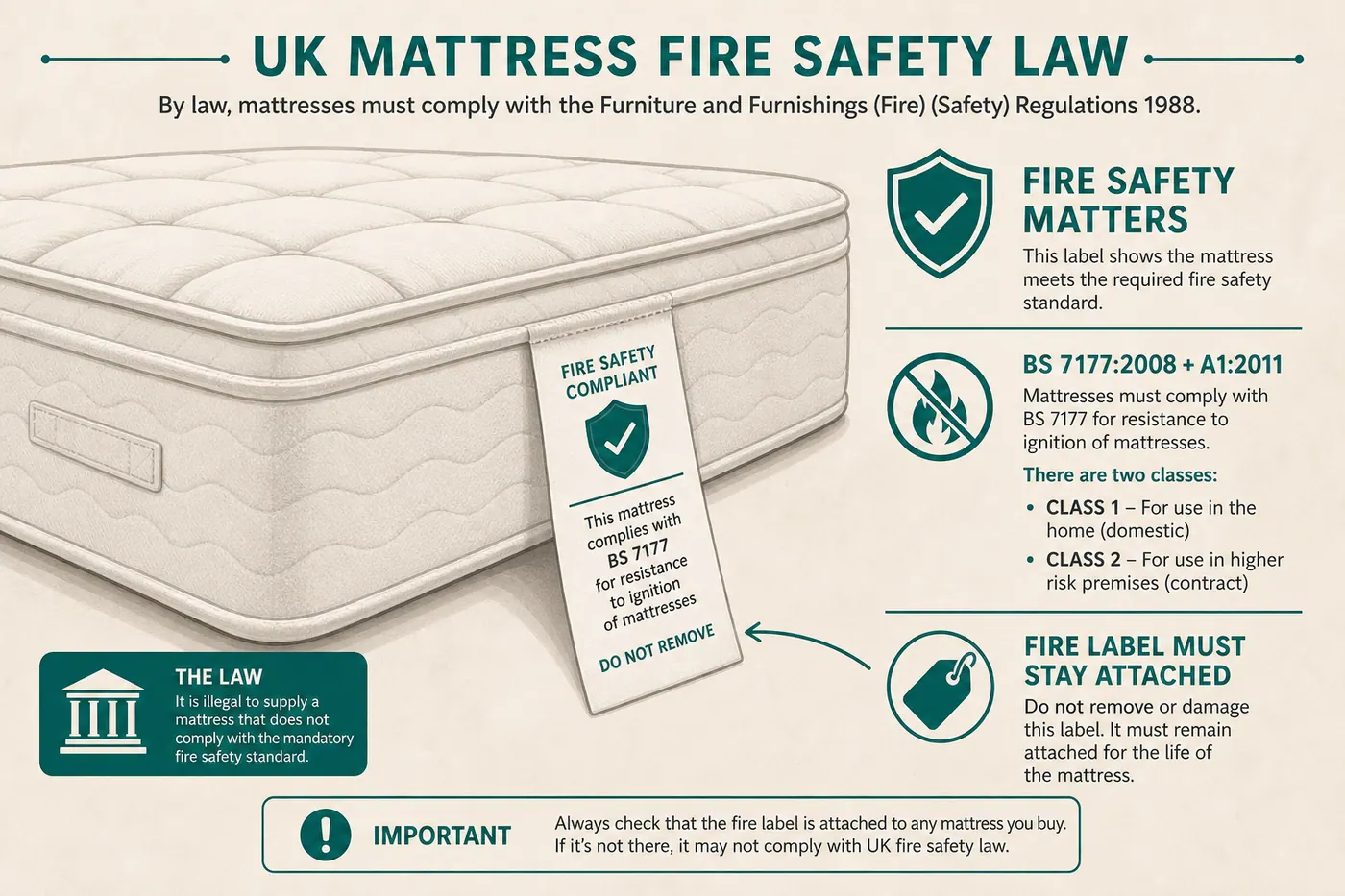
What does BS 7177 mean in plain words?
BS 7177 is a British Standard. Its full name is the specification for resistance to ignition of mattresses, mattress pads, divans and bed bases. Ignition means catching fire. So the standard says how hard it should be to set a mattress alight.
The British Standards Institution (BSI) publishes it. BSI lists BS 7177:2008+A1:2011 as current. It covers mattresses, mattress pads, divans and bed bases. BSI says it does not apply to mattress protectors.
BSI also says the test levels do not show how a mattress behaves in a fully developed fire. That is a fire that has already taken hold of a room.
In short: BS 7177 is about resisting the first spark or flame. It is not a promise the mattress cannot burn.
What are the BS 7177 hazard categories?
BS 7177 sorts mattresses by where they will be used. More risky places need tougher tests. SATRA, a UK test house, sums up the four grades like this.
| Hazard category | Tests it must pass | Typical places |
|---|---|---|
| Low hazard | A smouldering cigarette (EN 597-1) and a match-sized flame (EN 597-2) | Homes, including non-motorised caravans |
| Medium hazard | Low hazard tests, plus ignition source 5 from BS 6807 | Boarding schools, halls of residence, hostels, hotels, hospitals, homes for older people |
| High hazard | Low hazard tests, plus ignition source 7 from BS 6807 | Certain hospital wards, hostels, hotels, offshore sites, homes for older people |
| Very high hazard | High hazard tests as a minimum, plus extra tests the buyer sets | Locked psychiatric units and prison cells |
For hotels, hospitals and similar places, SATRA says the grade should follow a risk assessment. A home mattress is not tested as if it were a prison mattress.
How do BS 7177, BS 5852, Crib 5 and the 1988 regulations fit together?
These names are easy to mix up. Each one does a different job.
| Name | What it is | What it means for a mattress |
|---|---|---|
| 1988 Regulations | UK law on fire safety of home furniture | The fillings inside must pass ignition tests |
| BS 7177 | Standard for the finished mattress, pad, divan or bed base | Sets the hazard grade shown on the label |
| EN 597-1 and EN 597-2 | Cigarette test and match-flame test for mattresses | The two low hazard tests |
| BS 6807 | Flaming tests for mattresses, divans and bed bases | Adds bigger flames for contract grades |
| BS 5852 | Ignition tests for upholstered seating, covers and fillings | Used by the 1988 rules to test foam fillings |
| Crib 5 | Ignition source 5, a small stack of burning wood | Used by the 1988 rules to test foam fillings |
The full name of the 1988 law is the Furniture and Furnishings (Fire) (Safety) Regulations 1988. It covers beds, divans, mattresses and pillows. But not every part applies to mattresses.
- The cigarette test for upholstery and the match test for covers exclude mattresses and bed bases. Those tests are for sofas and chairs.
- The permanent label schedule also excludes mattresses and bed bases.
- The filling rules do apply. Foam, fibre and other fillings in a mattress must pass their ignition tests.
Trading Standards guidance says mattresses, divans and bed bases are covered separately by BS 7177. SATRA explains why. General product safety law says a mattress must be safe. Passing the right BS 7177 grade is the usual way makers show that.
“Crib” means a small wooden crib, like a tiny stack of sticks. The 1988 rules test foam with an “ignition source 5 crib” under BS 5852. That is why people say “Crib 5”. Separately, the medium hazard grade of BS 7177 adds an ignition source numbered 5, taken from BS 6807.
What does a mattress fire label look like?
SATRA describes the BS 7177 label from the standard. It shows a smouldering cigarette and a lit match. The word RESISTANT runs around the border. It then states the grade, such as domestic use (low hazard).
A clear mattress label should tell you:
- the standard, BS 7177
- the hazard grade, such as low hazard for domestic use
- enough detail to identify the maker and model
Keep the label attached. It is how you, a charity or a buyer can check the mattress later. Cutting it off can also cause warranty problems. See mattress certifications and labels for other marks.
Does a fire label mean the mattress will not burn?
No. The tests use set ignition sources under lab conditions. They do not make a mattress fireproof. Keep smoking materials, heaters, candles and damaged flexes away from bedding. An electric blanket has its own instructions.
What changed to UK fire-safety labels in 2025?
From 30 October 2025, the amended 1988 rules no longer require a display label on new products. A display label is the swing tag often seen in shops. The government says permanent-label duties for furniture have not changed.
For mattresses, this change matters less than it sounds. Mattresses and bed bases were already outside the 1988 display and permanent label schedules. Their fire label comes from BS 7177.
The same amendment removed some baby and children’s mattresses from the 1988 rules. It applies when both the length is under 170 cm and the width is under 75 cm. A 70 × 140 cm cot bed mattress is under both limits. A Small Single, 75 × 190 cm, is not.
These small mattresses must still meet general product safety rules. The government guidance names standards businesses may use, such as BS 7177 and EN 597. See the official 2025 guidance and the kids mattress guide.
Can I sell or donate a mattress without a label?
Usually you should not. Trading Standards guidance for businesses says used furniture must meet the same standards as new. For mattresses, it says to look for a BS 7177 label.
The same guidance says items without the right label may not comply. It advises not selling them until you get expert advice, for example from the maker. Items that cannot be checked should go to a recycling centre.
Charities that resell furniture check too. The British Heart Foundation says upholstered items must have a fire safety label. It also cannot take stained mattresses. Ask the charity before you book a collection.
If your mattress has no label, look at mattress recycling in the UK and delivery and disposal. For buying used, see second-hand mattress hygiene.
Does a mattress for a rental home or HMO need a different rating?
Trading Standards guidance says the furniture rules apply to lettings. That includes holiday homes and furnished homes let as a business. So landlords and letting agents are covered.
A furnished home is still a home. SATRA’s typical low hazard example is domestic dwellings. So a low hazard mattress is the usual grade for a normal let.
Shared housing is less clear. SATRA’s medium hazard examples include hostels, halls of residence and holiday camp chalets. A house in multiple occupation (HMO) is not named in that list. Ask the person doing your fire risk assessment, your council or your local fire and rescue service. This is not legal advice.
Do toppers and protectors need their own labels?
Toppers usually do. SATRA says BS 7177 treats anything slept on, including pads and toppers, as a mattress. Trading Standards guidance lists mattress pads and toppers under the filling rules too. Read the label on the topper itself.
Protectors are different. BSI says BS 7177 does not apply to mattress protectors. See protectors and encasements.
What else can break the labelled setup?
Removing the label. Replacing the cover with an unmarked one. Damaging the ticking, the outer fabric of the mattress. Each can make it harder to show what was tested.
Domestic grades are not contract grades. Do not use a low hazard mattress where a hotel, hostel or care setting needs a higher grade.
Related BedGuide entries
Frequently asked questions
What is BS 7177 on a mattress?
BS 7177 is the British Standard for resistance to ignition of mattresses, mattress pads, divans and bed bases. The label shows the grade for the intended use, such as domestic use (low hazard).
What does low hazard mean on a mattress label?
Low hazard is the grade for use in homes. The mattress has been tested against a smouldering cigarette and a match-sized flame. It is not a grade for hotels, hostels or hospitals.
What is the difference between BS 7177 and BS 5852?
BS 7177 sets fire performance for mattresses and bed bases. BS 5852 is a set of ignition tests for upholstered seating, its covers and fillings. The 1988 rules use BS 5852 to test foam fillings.
What is Crib 5?
Crib 5 is ignition source 5: a small stack of burning wood used as a test flame. The 1988 rules use it to test foam fillings. The BS 7177 medium grade also adds a source 5 test.
Does a fire label mean the mattress will not burn?
No. The tests measure resistance to set ignition sources in a lab. They do not make a mattress fireproof. Keep heaters, candles and smoking materials away from bedding.
Do toppers need fire labels too?
Often, yes. SATRA says BS 7177 treats anything slept on, including pads and toppers, as a mattress. Their fillings also sit under the 1988 rules. Read the topper's own label.
Does BS 7177 apply to mattress protectors?
The BSI listing for BS 7177 says the standard does not apply to mattress protectors. Pads and toppers can still sit under fire rules. Read the label on each extra layer.
Can I cut the fire label off?
Keep it on. The BS 7177 label is how you, a charity or a buyer can check the mattress later. Trading Standards guidance says unlabelled items may not comply and should not be resold without expert advice.
Does a UK mattress still need a fire safety swing label?
No swing label is needed. The 2025 change removed display labels from the 1988 furniture rules. Mattresses were already outside that label rule. Their label comes from BS 7177.
Are children's mattresses exempt from UK fire safety rules?
Baby and child mattresses under 170 cm long and under 75 cm wide are outside the 1988 furniture rules since October 2025. They must still meet general product safety rules.
Can I donate a mattress without a fire label?
Usually not. Charities that resell furniture, such as the British Heart Foundation, ask for a fire safety label. The British Heart Foundation also cannot take stained mattresses.
Does a rental property mattress need a special fire rating?
A furnished home you let is still a home, so low hazard is the usual grade. Hostels and halls of residence are typical medium hazard examples. Ask a fire risk assessor about shared housing.
Where do these facts come from?
BedGuide is desk research. The numbers and rules on this page were checked against the official or primary sources below. We name the check date. We do not invent a figure when a source is missing.
- Furniture and Furnishings (Fire) (Safety) Regulations 1988 — Official text. Mattresses count as furniture. Cover and upholstery tests exclude mattresses and bed bases. Checked 2026-09-25.
- 1988 Regulations — Schedule 7 (permanent labels) — The permanent label schedule applies to all furniture except mattresses and bed-bases. Checked 2026-09-25.
- 1988 Regulations — Schedule 1 (foam filling tests) — Polyurethane foam is tested to BS 5852 Part 2 with an ignition source 5 crib. Checked 2026-09-25.
- BSI Knowledge — BS 7177:2008+A1:2011 — Current standard. Covers mattresses, pads, divans and bed bases. Does not apply to mattress protectors. Checked 2026-09-25.
- BSI Knowledge — BS 6807:2006 — Flaming ignition tests for mattresses, upholstered divans and bed bases. Checked 2026-09-25.
- BSI Knowledge — BS 5852:2006 — Ignition tests for upholstered seating, covers and fillings, including wooden cribs. Checked 2026-09-25.
- SATRA — fire testing of beds — UK test house summary of BS 7177 hazard categories, their tests, typical settings, label design and toppers. Checked 2026-09-25.
- UK Office for Product Safety and Standards — 2025 fire safety amendment — From 30 October 2025: display labels removed, permanent-label duties unchanged, and the size-based children's mattress exclusion. Checked 2026-09-25.
- Business Companion (Trading Standards) — new upholstered furniture — Mattresses and divans are covered for fillings. Their labelling sits under BS 7177. The rules apply to landlords and letting agents. Checked 2026-09-25.
- Business Companion (Trading Standards) — second-hand upholstered furniture — Used furniture must meet the same standards. Look for a BS 7177 label on mattresses. Do not resell unlabelled items without advice. Checked 2026-09-25.
- British Heart Foundation — item condition for collections — One charity's donation rules. Upholstered items need a fire safety label. Stained mattresses are refused. Checked 2026-09-25.