care comparison
Turning (flip) vs Rotating (end-to-end)
Evergreen URL: /compare/turning-vs-rotating-mattress
In short
Rotating spins a mattress 180° so head and foot swap while the sleep surface stays up. Turning flips it upside down. Double-sided mattresses can use both; many modern single-sided pillow-top and foam hybrids are rotate-only.
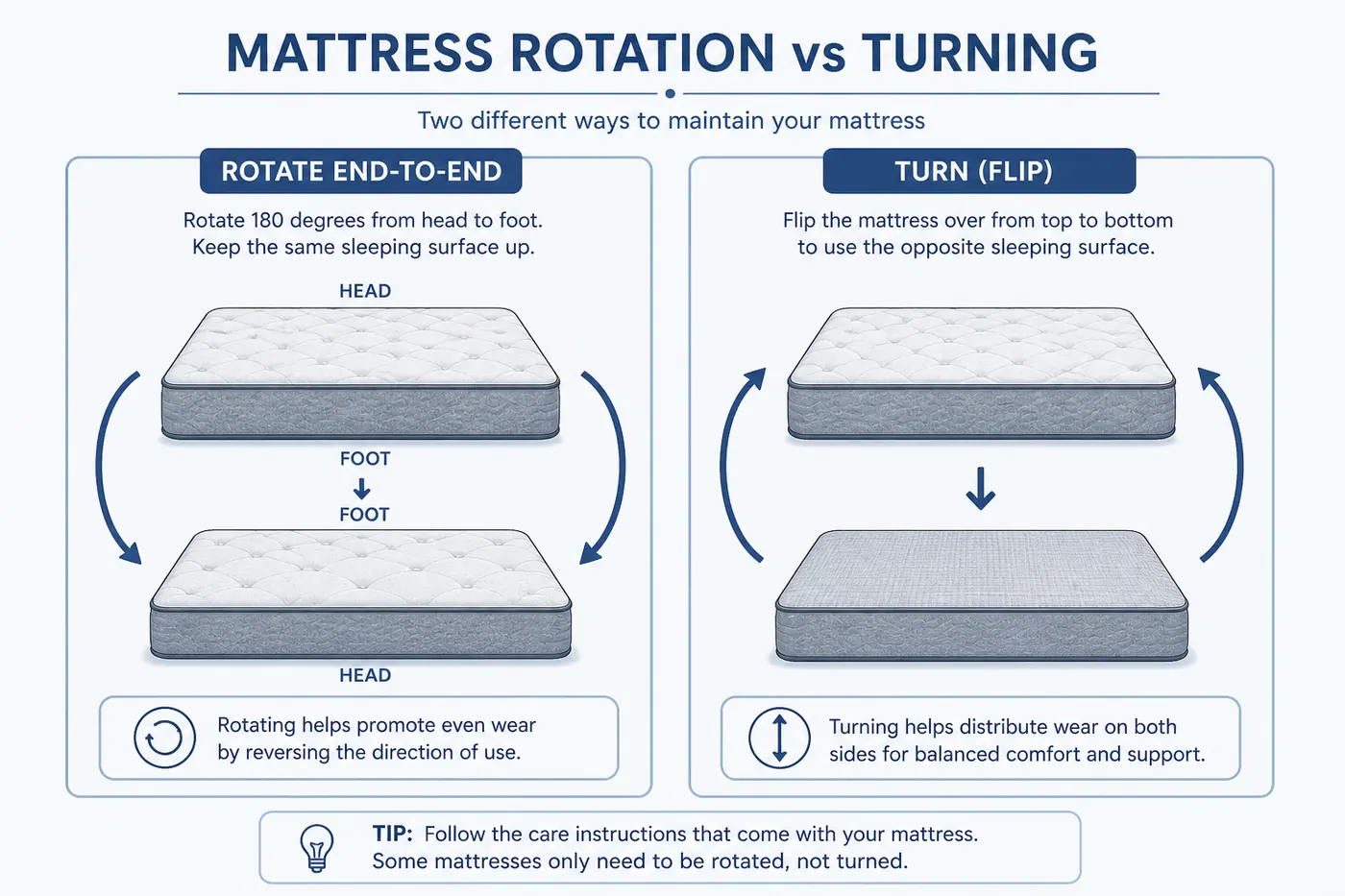
Using the wrong action can put a non-sleep face upward or stress handles. Read the care label first; use this comparison when the label is silent.
Key differences
| Criterion | Turning (flip) | Rotating (end-to-end) |
|---|---|---|
| Motion | Flip upside down | Spin 180° in plane |
| Sleep face | Changes to the former underside | Stays the same face |
| Single-sided / no-turn | Not allowed | Required maintenance action |
| Double-sided | Allowed — redistributes face wear | Allowed — redistributes length wear |
Turning (flip) may suit if…
- The mattress is explicitly double-sided / turnable
- Both faces are engineered as sleep surfaces
Rotating (end-to-end) may suit if…
- The mattress is no-turn / single-sided
- You need routine settlement management on one sleep face
Frequently asked questions
- How often should I rotate?
- Follow the manufacturer. A common UK pattern without instructions is weekly for the first three months, then monthly.