Memory Foam Mattress Materials Science
Entity: memory foam mattress
In short
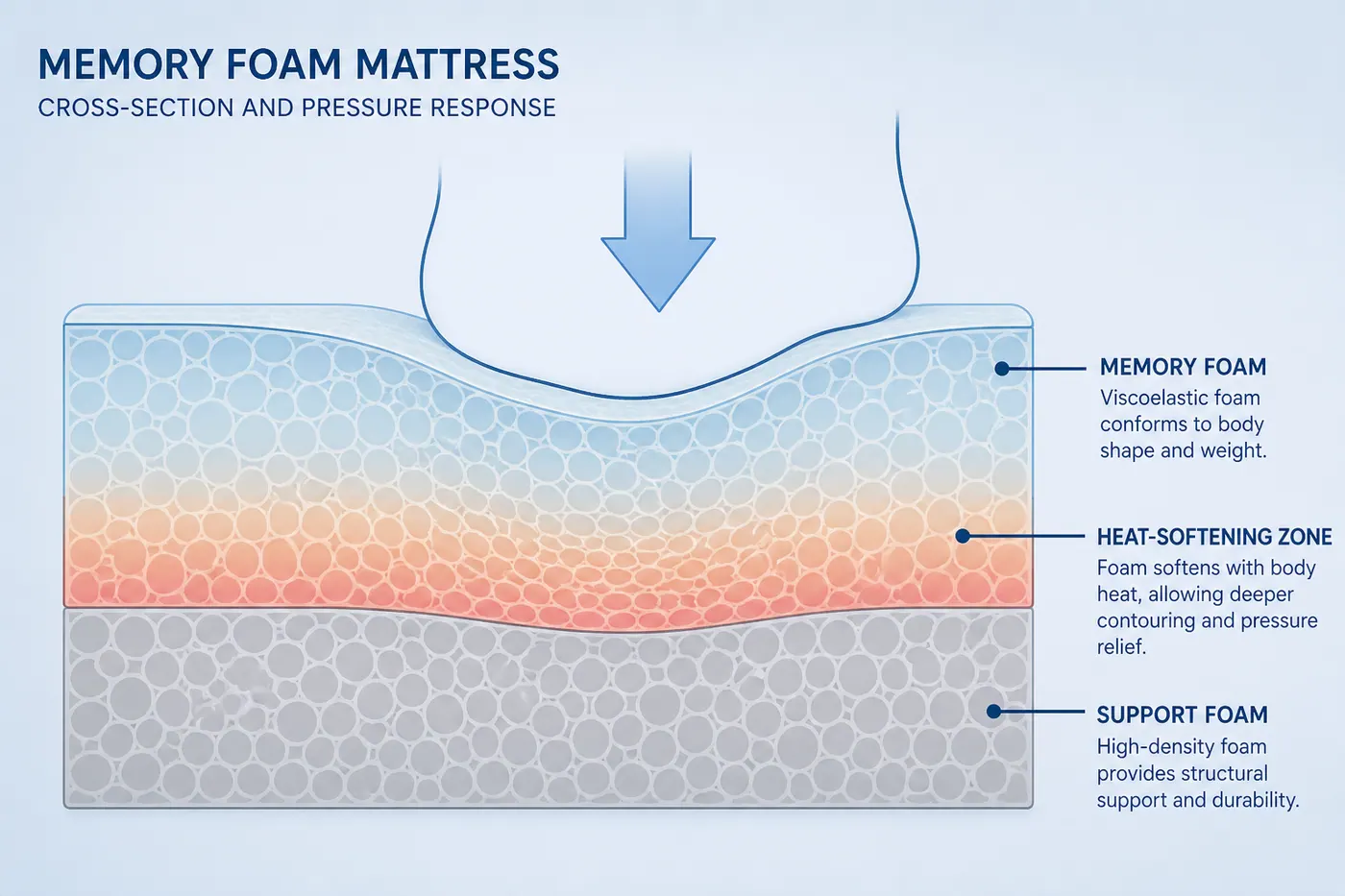
Memory foam is a type of polyurethane foam that slowly springs back after you press it. It also gets softer or firmer with temperature. Body heat softens the contact zone. A cooler room makes it feel firmer. Density in kg/m³ and indentation load deflection (ILD) describe the foam grade better than marketing thickness alone.
How it works
Materials used
- viscoelastic polyurethane foam
- support foam base layers
- cover textiles
Average lifespan
6– 8 years
How memory foam behaves
Memory foam (viscoelastic polyurethane) squashes under load and returns slowly when the load is removed. That slow return is what people feel as a “moulding” sensation. Pressure relief comes from spreading contact force over a larger area as the foam yields. That helps when shoulders and hips need sink for side-sleeping alignment.
Heat softens many memory foams. The same mattress can feel firmer when cold and more plush after body warmth builds. That temperature sensitivity is part of the material, not a defect.
Density vs hardness
| Metric | What it measures | Why it matters |
|---|---|---|
| Density (kg/m³) | Mass per volume | Often links to how long the foam lasts |
| ILD / IFD | Force to indent the foam | Describes soft vs firm feel |
High-density foam can still be soft. Low-density foam can feel firm but may wear sooner. Thickness alone does not define either metric.
Open-cell and gel-modified foams
Open-cell foam has more tiny air paths inside. That can feel cooler than classic slow-melting memory foam. Gel additives change how heat and touch feel. They do not turn foam into a different material.
Where memory foam sits in a mattress
- As a full foam core (specialty foam mattress)
- As a comfort layer over support foam
- As a comfort layer over pocket springs in a hybrid
Care rules for foam
Unlike spring units with large air gaps, foam cores dry slowly once soaked. Use a waterproof or tightly woven protector. Rotate end-to-end on the schedule in turning vs rotating. Follow cleaning memory foam for spot treatment only.
Related BedGuide entries
Frequently asked questions
- What is memory foam made of?
- Memory foam is viscoelastic polyurethane foam — a polymer that flows slowly and springs back gradually. It is not natural latex. Density (kg/m³) and hardness (ILD/IFD) describe grade more precisely than the word memory alone.
- Why does memory foam feel firmer in a cold bedroom?
- Memory foam softens as temperature rises. Body heat creates a more moulding contact zone. Cooler room conditions leave the foam stiffer until it warms. That is a material property, not a defect.
- Can you wash a memory foam mattress with lots of water?
- No. Soaking memory foam traps liquid inside and dries slowly. That risks odour and material breakdown. Use low-moisture spot cleaning and a washable protector. See BedGuide's cleaning guide for foam-safe methods.